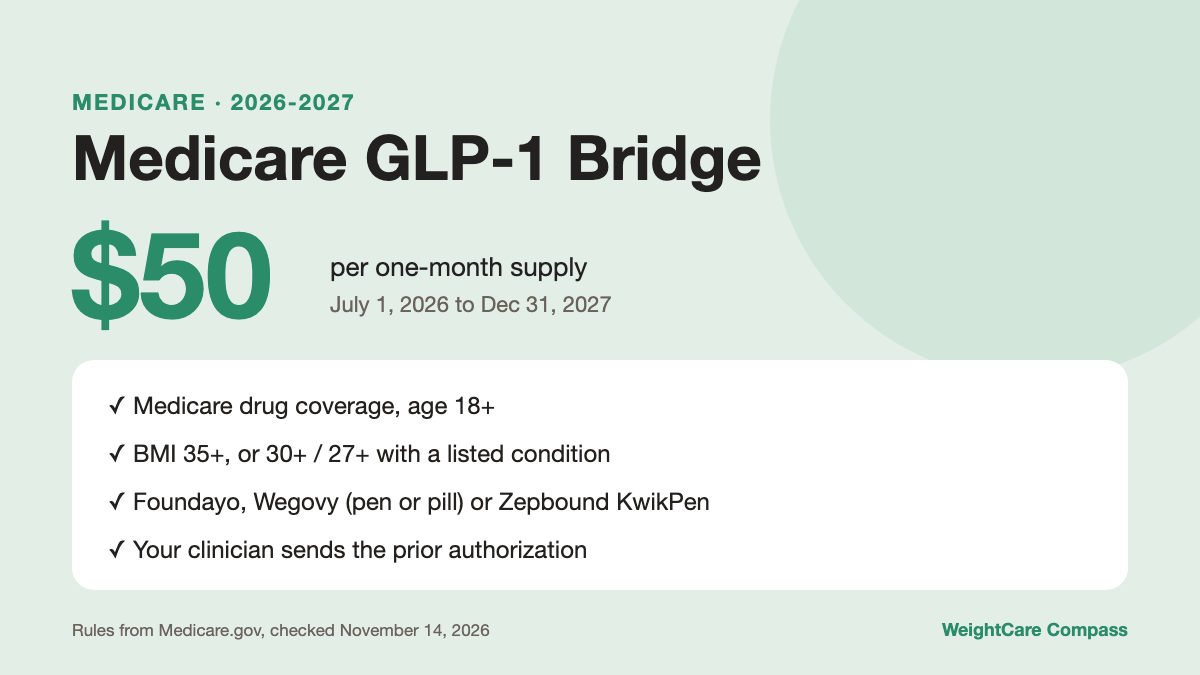
The Medicare GLP-1 Bridge program is a temporary CMS program that lets eligible people with Medicare drug coverage get Foundayo, Wegovy or Zepbound KwikPen for a $50 copay per one-month supply, from July 1, 2026 through December 31, 2027. The criteria cover BMI and certain health conditions. Meeting them makes you eligible for the $50 price, but your clinician decides whether a GLP-1 is right for you before prescribing it and requesting prior authorization.
The rules below come from Medicare.gov’s Bridge page and CMS, checked as of November 14, 2026. This page is for people on Medicare, and the family members who help them, who want a yes/no answer and the next step.
Key takeaways in 30 seconds
- You need Medicare drug coverage, be 18 or older, and meet one of three BMI paths (35+, or 30+ or 27+ with a listed condition). Meeting a path makes you eligible for coverage; your clinician decides if the drug suits you.
- Only three drugs: Foundayo, Wegovy (pen or pill) and Zepbound KwikPen.
- The $50 doesn’t count toward your Part D out-of-pocket limit, and Extra Help can’t lower it.
- There’s no patient application: your clinician sends the prescription and prior authorization.
Contents
What is the Medicare GLP-1 Bridge program, and how long does it last?
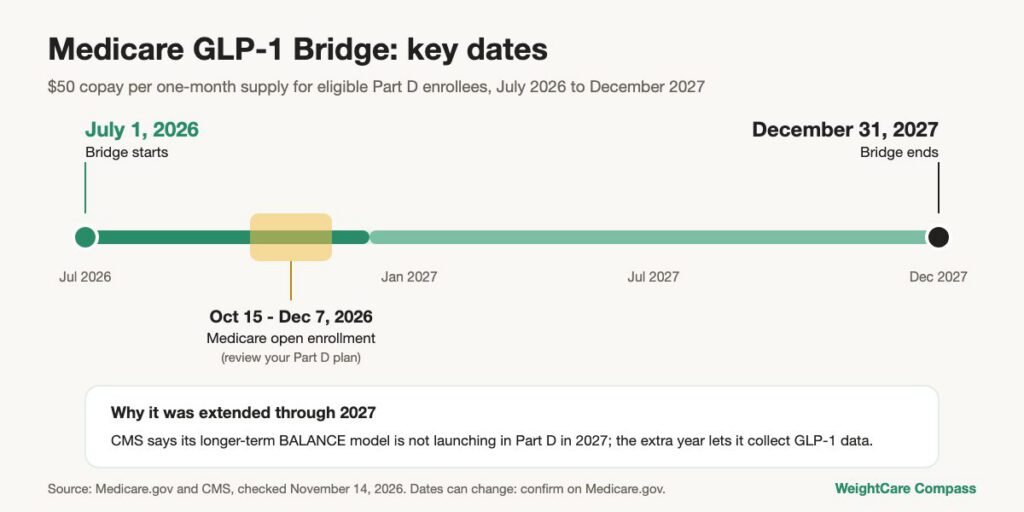
The Medicare GLP-1 Bridge is a short-term CMS demonstration that covers certain GLP-1 weight-loss drugs for eligible Part D enrollees between July 1, 2026 and December 31, 2027. It is separate from your regular drug plan.
According to the CMS Bridge FAQ, the program runs outside the Part D benefit. Your plan doesn’t pay for these drugs and doesn’t have to opt in. In 2026, a single central processor handles prior authorization (the approval step before a drug is covered), pharmacy claims and payment, CMS says.
Why “Bridge”? CMS says it extended the program through 2027 because its longer-term BALANCE model is not launching in Part D in 2027. The extra year lets CMS collect data on GLP-1 use ahead of a “potential” BALANCE launch in Part D.
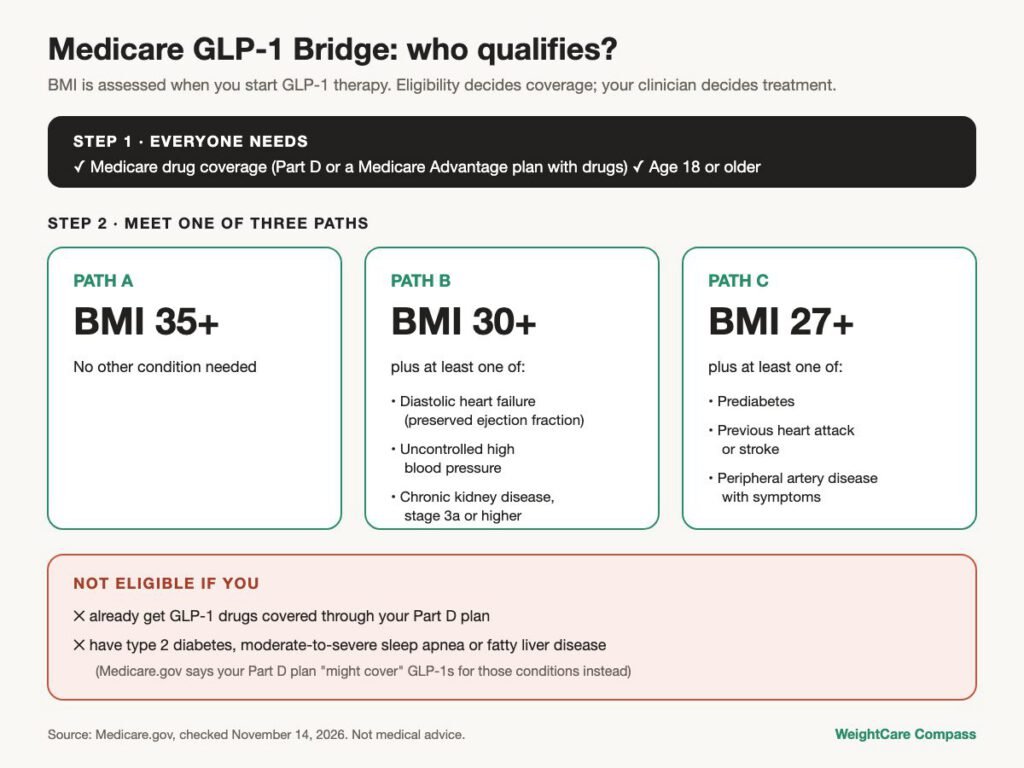
Who qualifies? Medicare GLP-1 Bridge program eligibility checklist
You qualify if you have Medicare drug coverage, are 18 or older, and meet one of three paths below when you start GLP-1 therapy. That last phrase is Medicare.gov’s wording: your BMI (body mass index, weight relative to height) is assessed at the start.
| Path | BMI when you start GLP-1 therapy | Plus at least one of these conditions |
|---|---|---|
| A | 35 or higher | None needed |
| B | 30 or higher | Diastolic heart failure (heart failure with preserved ejection fraction) · uncontrolled high blood pressure · chronic kidney disease stage 3a or higher |
| C | 27 or higher | Prediabetes · previous heart attack or stroke · blocked arteries in the legs or arms (peripheral artery disease) with symptoms |
These criteria decide coverage, not treatment. Your clinician confirms your BMI and looks at your other health conditions and medicines before deciding whether a GLP-1 is a good fit.
Not sure where you land? Check your BMI against the Bridge thresholds before you talk to your clinician.
You’re not eligible if you:
- already get GLP-1 drugs covered through your Part D plan;
- have type 2 diabetes, moderate-to-severe sleep apnea or fatty liver disease. Medicare.gov says your Part D plan “might cover” GLP-1s for those conditions instead.
Already paying out of pocket for a GLP-1? That doesn’t rule you out. Medicare.gov’s eligibility questionnaire says that if you started a GLP-1 for weight loss through a self-pay program (not through your Medicare drug coverage) before July 1, 2026, you may be eligible. You answer the BMI and health questions based on your health when you started the drug, not today. Your clinician can help you check, or call 1-800-MEDICARE if you’re unsure.
Which GLP-1 drugs does the Medicare GLP-1 Bridge program cover?
The GLP-1 Bridge covers three drugs only, according to Medicare.gov:
- Foundayo (orforglipron), tablet;
- Wegovy (semaglutide), injection or tablet;
- Zepbound (tirzepatide), KwikPen only. Single-dose Zepbound vials or pens are not covered.
Ozempic, Mounjaro and Rybelsus are not listed. Neither are compounded semaglutide or tirzepatide, which are not FDA-approved. If you’re choosing between the two covered pills, see how the two GLP-1 pills compare.
All three are FDA-approved for chronic weight management in adults; see the Foundayo label, the Wegovy label and the Zepbound label. Being eligible for the $50 price doesn’t mean one of these drugs is right for you.
Safety first: what the labels say
- Common side effects: nausea, diarrhea, vomiting, constipation and stomach pain, most often when the dose goes up.
- Kidneys: vomiting or diarrhea can cause dehydration, which can lead to kidney injury. This matters more if you already have kidney disease. Call your clinician if you can’t keep fluids down.
- Other serious risks the labels list: pancreatitis, gallbladder problems, serious allergic reactions, low blood sugar if you also take insulin or a sulfonylurea, and food entering the lungs during anesthesia or deep sedation. Tell your surgical or endoscopy team that you take a GLP-1. The Wegovy label also asks for regular heart-rate checks.
- Don’t use them if you or a family member have had medullary thyroid cancer (MTC), or if you have MEN 2.
- Tell your clinician first if you’ve had pancreatitis, gallbladder disease, kidney problems, severe gastroparesis or diabetic eye disease, and bring a list of all your medicines. Mention any past eating disorder too: weight-loss treatment needs extra care then.
- Never share an injection pen with anyone, even with a new needle. The labels say this for the Zepbound KwikPen and the Wegovy FlexTouch pen, which hold several doses.
When you lose weight, you lose some muscle along with the fat. This matters more as you get older. A joint advisory from four obesity and nutrition societies recommends getting enough protein and doing strength exercise during GLP-1 treatment. Ask your clinician or a dietitian what fits your health. Which drug and dose suits you, if any, is a decision for your clinician.
What does the $50 copay cover, and what doesn’t it count toward?
You pay $50 at the pharmacy for a one-month supply, which Medicare.gov defines as 28 or 30 days depending on the drug. Because a separate Medicare program pays, that $50:
- doesn’t count toward your Part D deductible or out-of-pocket limit;
- won’t appear on your Part D Explanation of Benefits or a Medicare Summary Notice;
- can’t be lowered by Extra Help (the low-income subsidy);
- can’t be spread over several months with the Medicare Prescription Payment Plan.
One extra cost for Zepbound KwikPen users: pen needles aren’t covered by the Bridge, so you buy them separately (CMS).
Manufacturer savings cards don’t stack: NovoCare and LillyDirect exclude government-insurance beneficiaries from their $25 cards.
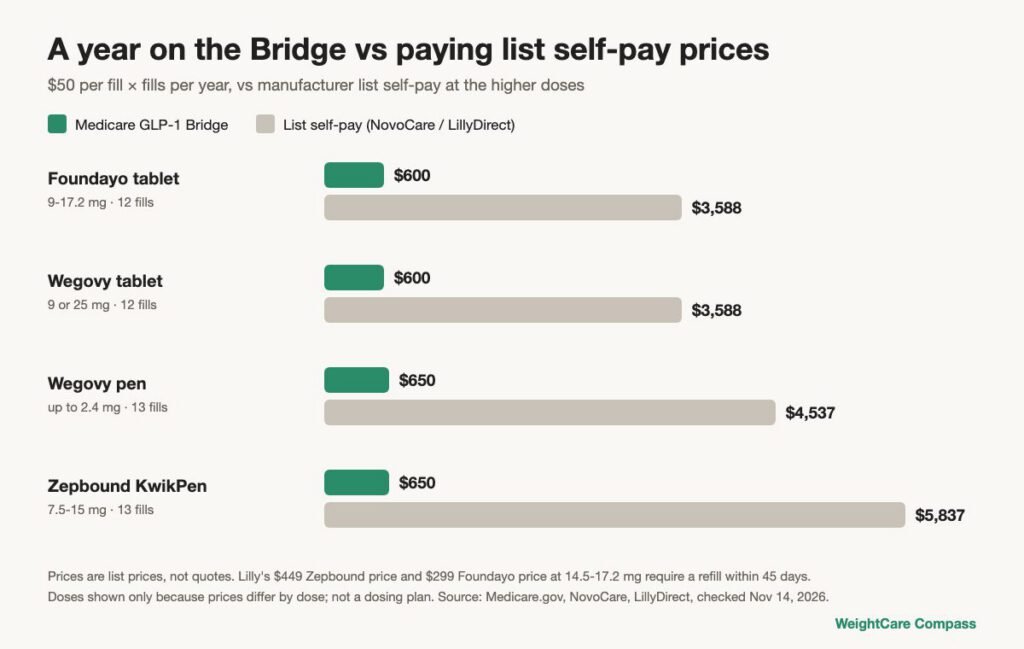
Medicare GLP-1 Bridge vs list self-pay prices: our yearly calculation
We multiplied $50 by the number of fills in a year: 12 for 30-day pill bottles, 13 for 28-day boxes of weekly pens. We compared that with the manufacturers’ list self-pay prices for the higher doses, as of November 14, 2026 (self-pay prices we track each month).
| Drug (form) | Fills a year | Bridge per year | List self-pay per year | Difference vs list price |
|---|---|---|---|---|
| Foundayo tablet, 9-17.2 mg (LillyDirect, $299/mo†) | 12 | $600 | $3,588 | $2,988 |
| Wegovy tablet, 9 or 25 mg (NovoCare, $299/mo) | 12 | $600 | $3,588 | $2,988 |
| Wegovy pen, up to 2.4 mg (NovoCare, $349/fill) | 13 | $650 | $4,537 | $3,887 |
| Zepbound KwikPen, 7.5-15 mg (LillyDirect, $449/fill*) | 13 | $650 | $5,837 | $5,187 |
*Lilly’s $449 price requires a refill within 45 days; otherwise 7.5 mg is $499 and 10-15 mg is $699. †At 14.5 mg and 17.2 mg, Lilly’s $299 price also requires a refill within 45 days; otherwise a higher regular price applies, which Lilly doesn’t list on that page.
Self-pay prices change, so treat the right-hand columns as list prices, not a quote. NovoCare says people with government insurance can use its self-pay prices if they pay outside their insurance, and those purchases don’t count toward Part D out-of-pocket costs; the LillyDirect pages we read don’t say either way. Doses are shown only because prices differ by dose; this is not a dosing plan. Your clinician decides your drug and dose, so don’t choose one because of this table. To run your own numbers, estimate your own yearly cost.
Medicare GLP-1 Bridge program: how to apply, step by step
There is no application for patients. Your clinician starts the process, and Medicare.gov describes these steps:
- Confirm you have Medicare drug coverage (plan types in the next section).
- Take Medicare.gov’s questionnaire, “Can I participate in the GLP-1 Bridge program?”, on the Bridge page.
- See your clinician. They send a prescription for a covered drug to the pharmacy and, when requested, complete the prior authorization. CMS asks prescribers to add an obesity diagnosis code and the note “SEND TO BRIDGE FOR WEIGHT MANAGEMENT”; without it, the pharmacy may bill your Part D plan instead. CMS posts the prior authorization form on its Bridge page.
- Lifestyle certification. Your clinician certifies that you use the drug as part of a lifestyle program focused on diet and exercise.
- Watch your mail. You get a letter confirming coverage. The pharmacy may ask for your Medicare Number or the last 4 digits of your Social Security Number.
- Refills. The approval stays valid for refills and dose changes through December 31, 2027, unless you change GLP-1s. Switching drugs means a new prior authorization.
The CMS prescriber fact sheet explains what happens next. The pharmacy usually sends the prior authorization request to your clinician electronically or by fax within 24-72 hours. The decision is mailed to you, and sent to your clinician, within 72 hours of submission. CMS’s page for providers says there is no appeals process, but your clinician can resubmit the form with corrected or new information. As for who runs the central processor, Healthcare Finance News reported at launch that it would be Humana; we have not seen that on a CMS page.
Some telehealth programs, such as Weight Watchers Med+, say on their own pages that they support the Bridge. We have not reviewed how they handle it. You don’t need a telehealth program: any clinician who can prescribe, including your regular doctor, can start the process.
Does open enrollment change the Medicare GLP-1 Bridge program?
Not directly. The GLP-1 Bridge doesn’t depend on which plan you choose, because CMS says Part D sponsors don’t have to opt in. What matters is having Medicare drug coverage.
Medicare.gov lists the plan types that count: a standalone drug plan (PDP), a Medicare Advantage plan with drug coverage (HMO, HMOPOS, Local or Regional PPO), a Special Needs Plan (SNP), an employer/union group waiver plan (EGWP) or the LI NET program. If you have Medicare without drug coverage, you can’t use the Bridge. People whose only coverage is a private fee-for-service plan, a cost plan or a PACE organization aren’t eligible either, unless they also have a standalone drug plan, according to Medicare.gov’s fact sheet. Open Enrollment runs October 15-December 7, and a plan that gets your request by December 7 starts January 1 (Medicare.gov).
Not confirmed yet: whether an existing Bridge approval carries over automatically if you switch Part D plans for 2027. No CMS or Medicare.gov page we read answers it. Ask 1-800-MEDICARE before you change plans.
Medicare GLP-1 coverage in 2027 and after: what about Medicaid?
The Medicare GLP-1 Bridge program is set to end December 31, 2027, along with every approval issued under it. CMS ties what comes next to a “potential implementation of BALANCE in Part D”; as of November 14, 2026, CMS has not announced what, if anything, replaces the Bridge in 2028.
Plan for this before you start. GLP-1s for weight are usually long-term treatments. In the SURMOUNT-4 trial, adults with obesity or overweight (average age 48) who switched from tirzepatide to placebo after 36 weeks saw their weight go back up by 14% on average over the next year, while those who stayed on it lost a further 5.5% on average. Ask your clinician what your options would be if coverage ends, and don’t stop or change your medicine on your own.
The Bridge is a Medicare program. Medicaid coverage of GLP-1s for weight depends on your state, so ask your state Medicaid agency. If you have both Medicare and Medicaid, your drug coverage comes through Medicare (for example an SNP), so you can use the Bridge if eligible, but Extra Help won’t lower the $50.
What to read next
- Foundayo vs Wegovy pill: if you qualify, compare the routine and side effects of the two covered pills.
- Weight-loss program prices: if you don’t qualify, see what each program and manufacturer charges this month.
- GLP-1 cost calculator: put your own dose and timeline into a yearly total.
Medicare GLP-1 Bridge program: frequently asked questions
What is the Medicare GLP-1 Bridge program phone number?
Call 1-800-MEDICARE (1-800-633-4227) for questions about your eligibility or coverage under the Medicare GLP-1 Bridge; TTY users can call 1-877-486-2048. Clinicians with technical questions can write to CMS’s Bridge mailbox, glp1demo@cms.hhs.gov, without sending personal health information.
How do you bill the Medicare GLP-1 Bridge program?
As a patient, you don’t bill anything. You pay the $50 copay at the pharmacy, and the pharmacy’s claim goes to the Bridge’s central processor rather than your Part D plan, because CMS runs the program outside the Part D payment flow. Pharmacies and prescribers can find their instructions on the CMS Bridge page.
How is the Medicare GLP-1 Bridge program going?
As of November 14, 2026, CMS has not posted enrollment numbers on its Bridge page. Press coverage exists, but we only report figures that CMS publishes. We’ll update this answer when CMS releases data.
Is there a Medicare GLP-1 Bridge program requirements PDF?
Yes. Medicare.gov publishes a fact sheet, “Medicare GLP-1 Bridge: GLP-1 drugs for $50 a month” (publication 12234). For clinicians and pharmacists, CMS’s Bridge page links the prior authorization form and dedicated pages for providers and pharmacies, including the prescriber fact sheet.
This article is for information only and does not replace advice from your healthcare provider. Talk to your doctor or pharmacist before starting, stopping or changing any medication, and call 1-800-MEDICARE for questions about your coverage. How we work: every claim is checked against Medicare.gov, CMS, the current FDA labels and published research, and we state when something could not be confirmed. Program rules and prices change; we last checked them on November 14, 2026.