GLP-1 vision loss is now an FDA safety concern: on November 9, 2026, the FDA began requiring every GLP-1 medicine to add a label warning about a “potential increased risk” of NAION, a rare eye condition that can cause sudden, painless vision loss in one eye. The added risk is small in absolute terms, and eye-doctor groups stress that it has not been established that the drugs cause it.
If you notice sudden vision loss in one eye, seek care right away. Decide any treatment change with your prescriber.
Key takeaways in 30 seconds
- In 126 trials: 6.4 vs 3.8 NAION cases per 100,000 person-years, about 2.6 extra cases, from only 15 events.
What did the FDA announce on November 9, 2026?
The FDA is requiring the makers of all GLP-1 receptor agonists to add this risk to the Warnings and Precautions section of their labels. The FDA says NAION cases have been reported for every GLP-1 on the market.
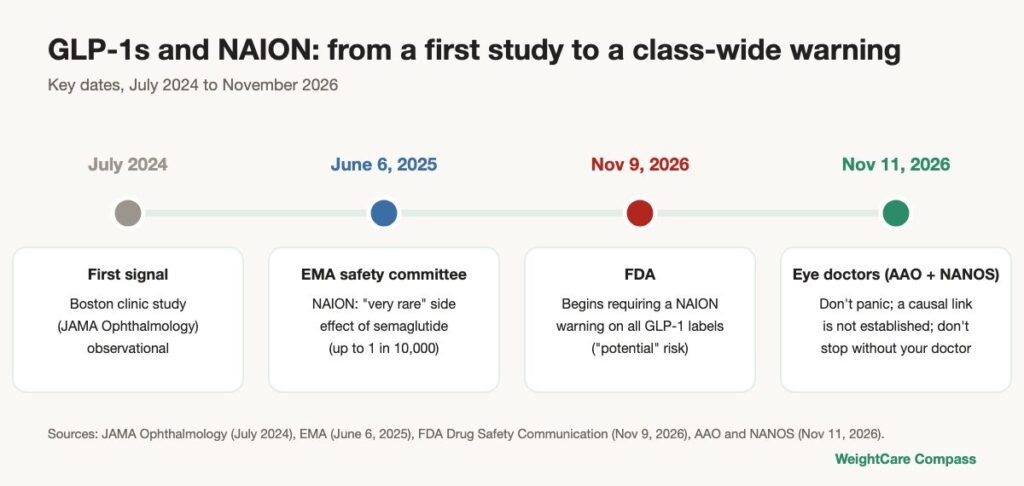
The review began after a July 2024 study from a Boston eye practice, then covered trials, insurance data, published studies, animal data and adverse event reports.
| Ingredient | Type 2 diabetes brands | Weight management brands |
|---|---|---|
| semaglutide | Ozempic, Rybelsus | Wegovy |
| tirzepatide* | Mounjaro | Zepbound |
| liraglutide | Victoza, Xultophy | Saxenda |
| orforglipron | Foundayo | |
| dulaglutide, lixisenatide, exenatide | Trulicity, Soliqua, generic exenatide |
*Tirzepatide also acts on GIP receptors. Source: FDA (12 products). Compare them in GLP-1 weight-loss medications; Foundayo is covered in Foundayo vs Wegovy pill.
On June 6, 2025, the European Medicines Agency’s safety committee concluded that NAION is a “very rare” side effect of semaglutide, the only GLP-1 it reviewed (“may affect up to 1 in 10,000 people”) and said treatment “should be stopped” if NAION is confirmed. The FDA’s wording covers all GLP-1s and is softer: prescribers should “consider discontinuing” the drug in patients who develop NAION “unless the benefits of treatment clearly outweigh the risk.”
Compounded semaglutide and tirzepatide are not FDA-approved, so they have no FDA-approved label for this warning to appear on, and the FDA does not review them for safety, effectiveness or quality. Some compounded semaglutide even uses salt forms the FDA calls different active ingredients. If you use a compounded GLP-1, ask your prescriber how this warning applies to you.
What is NAION, and who is at higher risk?
NAION (non-arteritic anterior ischemic optic neuropathy) is a condition in which reduced blood flow to the front of the optic nerve damages sight in one eye. Its cause is not completely understood and the loss can be permanent, according to the FDA. In adults over 50, it occurs in 2.3 to 10.2 people per 100,000 each year.
People who already had NAION face a higher risk of recurrence, including in the other eye, and should tell their prescriber before starting a GLP-1. Other risk factors may include smoking, diabetes, high blood pressure, sleep apnea, anemia and kidney disease, according to the FDA.
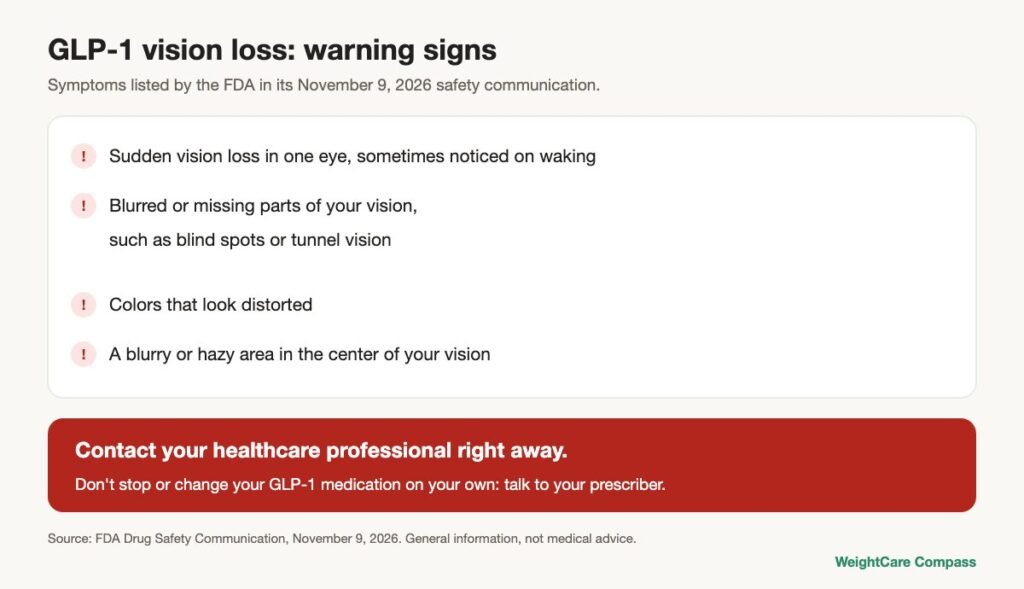
NAION symptoms listed by the FDA: contact your healthcare professional right away if you notice
- sudden, painless loss of sight in one eye, sometimes on waking
- blurred or missing parts of your vision, such as blind spots or tunnel vision
- distorted colors
- blurry or hazy spots in the center of your vision
How big is the GLP-1 vision loss risk in real numbers?
Small. Across the 126 randomized trials pooled by the FDA (134,253 people), there were 15 probable NAION cases: 10 on a GLP-1 and 5 on placebo (none on other diabetes drugs). That is 6.4 cases per 100,000 person-years on a GLP-1 versus 3.8 in the comparison groups. A person-year is one person followed for one year.
“About 1.7 times the risk” is the relative view. The absolute view: about 2.6 extra cases per 100,000 person-years, or 1 extra case per roughly 38,700 years of treatment (our calculation from FDA figures). With 15 events, this is imprecise; the FDA published no confidence interval.
Depending on the study, the extra risk ranges from about 3 to 14 cases per 100,000 person-years, and the FDA’s insurance data found no significant difference versus SGLT-2 inhibitors:
| Source | Evidence | GLP-1 vs comparison (per 100,000 PY) | Extra cases per 100,000 PY |
|---|---|---|---|
| FDA, 126 trials | randomized | 6.4 vs 3.8 (placebo or another diabetes drug) | ≈ 2.6 (our calculation) |
| EMA 2025, semaglutide, type 2 diabetes | observational | about twice non-users | ≈ 10 (EMA: about 1 per 10,000 PY) |
| Denmark-Norway registries 2025 | observational | 21.9 vs 11.8 (Denmark, unadjusted, vs SGLT-2 inhibitors) | ≈ 14 (study’s adjusted pooled figure, Denmark + Norway) |
PY = person-years. SGLT-2 and DPP-4 inhibitors: other diabetes drugs.
Does GLP-1 cause vision loss? What the studies prove
Not proven. The evidence points to a credible link with a small increase in NAION risk, but cause and effect has not been established. A hazard ratio (HR) of 2 means about twice the rate.
| Evidence | Finding | Limits | Our grade |
|---|---|---|---|
| FDA pool, 126 randomized trials | 6.4 vs 3.8 per 100,000 PY | only 15 events | B |
| FDA Sentinel insurance data | HR 1.19 vs SGLT-2 (not significant), 1.43 vs DPP-4 | diabetes only | C |
| Simonsen 2025, national registries | HR 2.81 | diabetes, semaglutide; 32 events | C |
| Cai 2025, 37.1 million US adults with type 2 diabetes | “modest” increase | relies on diagnosis codes | C |
| Hathaway 2024, one Boston practice | HR 4.28 to 7.64 | referred patients, small numbers | C |
| Animal data (FDA) | no mechanism identified | C |
Grades follow how we evaluate evidence: B for the pooled randomized trials, C for observational and animal data, even large ones. What this means:
- The scariest numbers came from a special group. The 2024 study involved patients already referred to neuro-ophthalmologists, which inflates rates.
- Larger studies found smaller effects. The registry authors say the absolute risk “remains low”; the US analysis found an increase “smaller than that previously reported.”
- Gaps remain. Most data involve semaglutide in type 2 diabetes, with less on tirzepatide or on use for weight alone.
What should you do if you take a GLP-1 or plan to start one?
On November 11, 2026, the American Academy of Ophthalmology and the North American Neuro-Ophthalmology Society urged patients not to panic and said the FDA’s review matches their own conclusions:
- New vision symptoms (list above), or any sudden loss or rapid worsening of vision, painful or not: contact your healthcare professional right away. The AAO advises prompt evaluation by an ophthalmologist.
- Don’t stop or change your medication without talking to your prescriber.
- If NAION is diagnosed, the FDA says to discuss with your healthcare professional whether to continue or stop the GLP-1.
- No extra eye exam just for this: the AAO and NANOS don’t recommend routine eye exams solely to check NAION risk before starting a GLP-1. People with diabetes keep their regular diabetic eye exams.
- Report side effects to FDA MedWatch or 1-800-332-1088.
What to read next
- Foundayo vs Wegovy pill: the two GLP-1 pills compared.
- GLP-1 side effects and safety: other side effects and FDA updates.
- Cheapest GLP-1 without insurance: if you and your prescriber decide to continue.
Frequently asked questions
Can Ozempic cause blindness?
Concerns about Ozempic vision loss center on NAION. Ozempic (semaglutide) is covered by the FDA warning, which describes a possible small increase in NAION risk. NAION affects one eye, sometimes permanently. A link is not proof that Ozempic causes it.
Is GLP-1 vision loss reversible?
The FDA says NAION can cause permanent vision loss. We found no reliable recovery figure for GLP-1 users. Prompt evaluation confirms the diagnosis so you and your prescriber can review treatment.
How could a GLP-1 cause vision loss?
Nobody knows yet. The FDA’s review of animal data found no mechanism, and NAION’s own cause is not fully understood. The FDA describes the risk as “potential.”
Do Zepbound and Mounjaro carry the same warning?
Yes, the requirement covers both. Tirzepatide, the active ingredient in both, is on the FDA’s list, and the FDA is requiring the warning for every GLP-1, including Zepbound and Mounjaro.
For information only, not a substitute for medical advice (see our medical disclaimer). Method: we read the FDA, EMA and AAO/NANOS statements and the study abstracts; “our calculation” is a simple difference between published rates. Last checked November 14, 2026.