We may earn a commission if you sign up or buy through links on this page. This doesn’t affect our rankings, which follow our methodology.
Insurance dropping GLP-1 coverage in 2027 usually means your plan stops paying for drugs like Wegovy and Zepbound when they’re prescribed for weight loss, while type 2 diabetes coverage often stays. Start with your plan’s 2027 drug list. Then pick a route: new criteria, another covered use, an exception or appeal, a plan switch, Medicare, or self-pay with HSA or FSA money.
This page is for anyone holding a 2027 benefits notice, or expecting one. Every rule and deadline below is checked as of November 14, 2026. Which medicine you take stays a decision for you and your prescriber.
Key takeaways in 30 seconds
- The cuts we verified target the weight-loss use; where stated, diabetes coverage continued.
- “Dropped” can mean an exclusion, new prior authorization rules, a required program or a higher copay. Only an exclusion ends coverage for that use, and even then other routes remain.
- Deadlines: Medicare open enrollment ends Dec 7; HealthCare.gov sign-up by Dec 15 for Jan 1; appeals within 180 days of a denial.
- Losing one drug benefit doesn’t open a Special Enrollment Period.
Contents
Who is dropping GLP-1 coverage for 2027, and why?
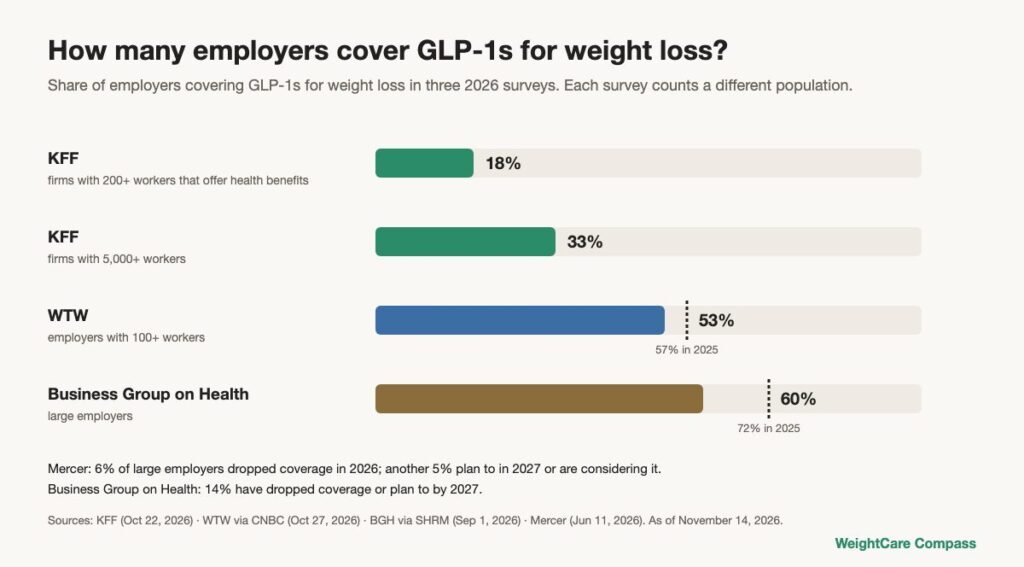
Employers make most of these decisions, and cost is the reason. Most surveys show employer GLP-1 coverage for weight loss shrinking, though KFF found it roughly flat. The numbers differ because each survey asks a different group.
- KFF’s 2026 Employer Health Benefits Survey, October 22, 2026: 18% of firms with 200+ workers that offer health benefits cover GLP-1s used primarily for weight loss in their largest plan (33% at 5,000+). Among non-covering firms, 12% stopped in the past year.
- WTW, employers with 100+ workers (CNBC, October 27, 2026): 53% cover them, down from 57% in 2025.
- Business Group on Health, large employers (SHRM, September 1, 2026): 60% cover them for obesity, down from 72%; 14% have dropped it or plan to by 2027.
- Mercer’s 2027 strategy survey, June 11, 2026: 6% of large employers dropped coverage in 2026; another 5% plan to in 2027 or are considering it.
Why now? Covering these drugs typically costs employers in the “mid-$500s to mid-$600s per user monthly,” CNBC reported. Business Group on Health projects a median 9.2% rise in health costs for 2027 before plan changes.
Here are the changes we could confirm with a primary source or a major news outlet, as of November 14, 2026:
| Who | What changed | Effective | Still covered | Source |
|---|---|---|---|---|
| Cigna, its own employee plan only (not Cigna Healthcare customers) | GLP-1s for weight loss excluded | July 1, 2026 | Type 2 diabetes | WFSB, Sep 2, 2026 |
| PepsiCo (some employees) | Weight-loss drugs no longer covered | October 2026 | Not stated | Bloomberg via Claims Journal, Aug 26, 2026 |
| Starbucks (benefits-eligible employees) | GLP-1s prescribed for weight loss excluded | October 2026 | May remain for other conditions | SHRM, Aug 13, 2026 |
| Massachusetts GIC (state workers) | 10-7 vote to end weight-loss coverage | Plan year starting July 2026 | Other conditions, such as diabetes | GBH News, Feb 26, 2026 |
| Blue Cross Blue Shield of Massachusetts (insurer) | Standard plans stop covering GLP-1s for weight loss; employers with 100+ workers could keep it for an extra charge | Jan 1, 2026 | Diabetes | Boston Globe, Apr 17, 2025 |
| Federal employees (FEHB/PSHB) | Not dropped: at least one GLP-1 stays covered, with intensive behavioral therapy required before and during treatment (OPM guidance) | 2027 plan year (Open Season Nov 9-Dec 14, 2026) | Yes, with the program | OPM Carrier Letter 2026-07, Mar 31, 2026 |
| CVS Caremark (pharmacy benefit manager) | Zepbound back as a preferred option on its main commercial drug lists, “for plan sponsors who elect” coverage | Oct 1, 2026 | Depends on your employer | CVS Health, May 28, 2026 |
Online lists of “companies dropping GLP-1 coverage” include employers we couldn’t confirm, so we leave them out. See how we verify company decisions.
Is your GLP-1 really being dropped? How to read your 2027 plan
Not always. A benefits notice can mean a full exclusion, or new rules you may still meet. Four documents tell you which:
- The 2027 Summary of Benefits and Coverage (SBC), the standard plan summary every plan must give you. HealthCare.gov explains what it contains.
- The 2027 drug list (formulary). Look up your medicine by name (Wegovy, Zepbound, Foundayo or the Wegovy pill) and check which use is covered.
- The prior authorization criteria, the conditions the insurer or pharmacy benefit manager checks before it pays.
- Your open-enrollment notice or benefits guide, which often explains the reason for the change.
Then match the wording to what it means:
| What the notice says | What it means | Still a path? |
|---|---|---|
| Excluded for weight loss or weight management | The plan won’t pay for that use | Only through another covered use or an exception |
| New prior authorization or BMI criteria | The plan pays if your records meet its rules | Yes |
| Step therapy | You must try another covered treatment first | Yes, with your clinician |
| Higher tier or flat copay | Still covered; you pay more | Yes |
| Required lifestyle or coaching program | Coverage depends on joining a program (KFF: 40% of covering firms require one) | Yes |
| Covered for certain diagnoses only | For example, diabetes or sleep apnea | Partly |
Who decided? In a self-funded plan, your employer (the plan sponsor) chooses. In a fully insured plan, the insurer sets the standard benefit, but employers can sometimes buy coverage back: Mass General Brigham Health Plan let employers with 50 or more enrolled subscribers add weight-management coverage back when their plans renewed in 2026. Ask HR whether that exists for you.
Why you may not have been warned. Federal rules require 60 days’ notice of an SBC change only when it happens mid-year. A renewal change shows up in the new SBC, so a January 1 change may appear only in your open-enrollment packet.
Then ask HR or your plan three questions: Is my medicine excluded or under new criteria? Does my current prior authorization carry into 2027? Is there an exception process?
Insurance dropping GLP-1 coverage? Match your situation to a first move
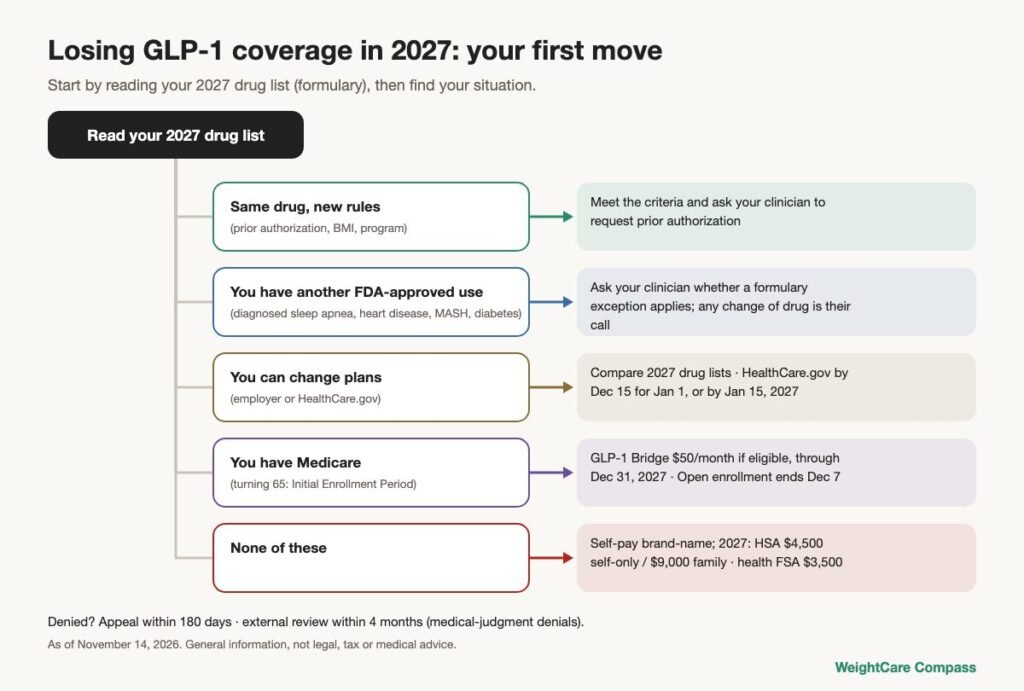
Your first move depends on whether the plan excludes the drug or only adds rules, and whether you have another plan or Medicare. We compared seven routes: (1) meet the new criteria, (2) another covered use, (3) an exception or appeal, (4) a plan switch at open enrollment, (5) an employer alternative program, (6) self-pay with HSA or FSA money, and (7) the Medicare GLP-1 Bridge.
| Your situation | Best first move | Backup | Deadline | Where the cost is |
|---|---|---|---|---|
| New hoops: prior authorization, BMI threshold, program or higher copay | Clinician documents the criteria and requests prior authorization early | Appeal if denied | Before your current approval ends, or Jan 1 | Compare your new copay with self-pay |
| Weight-loss use excluded, but you have a diagnosed condition such as moderate to severe sleep apnea, established heart disease, MASH or type 2 diabetes | Ask your clinician whether another FDA-approved use truly applies to you; any change of drug is their call | Exception or appeal | Plan renewal date | Other covered uses |
| Excluded, another plan available | Compare 2027 drug lists before enrolling | Self-pay | Employer window; HealthCare.gov Dec 15 (Jan 1 start) or Jan 15, 2027 | Plan switching |
| Excluded, no other plan | Self-pay brand-name with HSA or FSA money; ask HR about programs | Exception request | FSA election at your employer’s open enrollment | The cheapest brand-name GLP-1s without insurance |
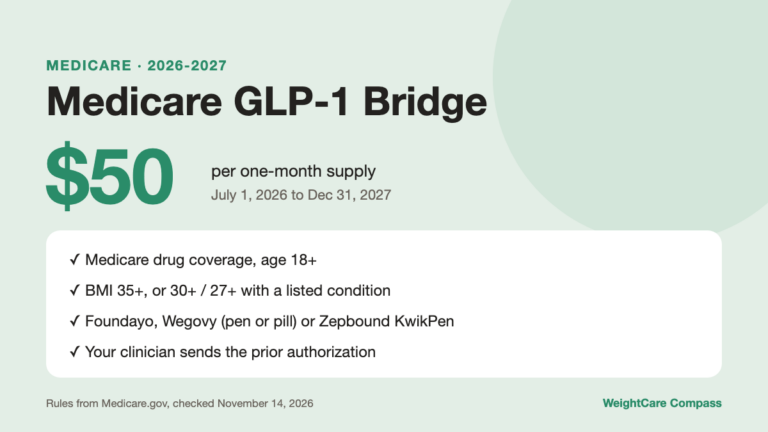
| On Medicare, or turning 65 in 2027 | Check Medicare GLP-1 Bridge eligibility | Part D plan review | Medicare open enrollment ends Dec 7 (turning 65: your Initial Enrollment Period) | The $50 Medicare GLP-1 Bridge |
Deadlines are as of November 14, 2026; prices live on the linked pages.
Can your GLP-1 still be covered for sleep apnea, heart disease, liver disease or diabetes?
Sometimes, yes. Many exclusions target the weight-management use only, and several drugs have other FDA-approved uses. Others exclude the drug itself: Mass General Brigham Health Plan now covers GLP-1s for its fully insured members only for type 2 diabetes. Check how your plan words its exclusion. Starbucks said coverage may remain for other conditions; Cigna’s employee plan and the Massachusetts GIC kept diabetes coverage.
FDA-approved uses beyond weight management:
- Zepbound: moderate to severe obstructive sleep apnea in adults with obesity (FDA, December 20, 2024).
- Wegovy: reducing the risk of major cardiovascular events in adults with established cardiovascular disease and either obesity or overweight (FDA, March 8, 2024).
- Wegovy: noncirrhotic MASH, a serious fatty liver disease, with moderate to advanced liver scarring (stages F2 to F3) in adults, under the FDA’s accelerated approval (FDA, August 15, 2025).
- Ozempic and Mounjaro: type 2 diabetes. They are not approved for weight loss.
Coverage for these uses follows your plan’s own criteria, and plans may ask for proof, such as a sleep study for sleep apnea. This is not a workaround: the diagnosis must be real and documented by your clinician.
Some plans also cover other weight-loss medicines. Federal employee plans, for example, must cover at least two oral anti-obesity medicines in addition to a GLP-1, under OPM’s carrier guidance. Whether any suits you is a question for your clinician.
How do you ask for a formulary exception or appeal a GLP-1 denial?
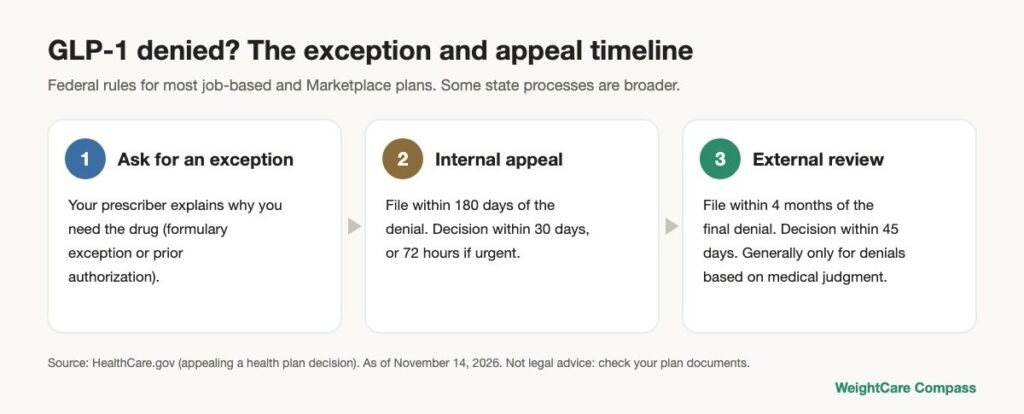
Start with your prescriber. A formulary exception is a request, usually made by your prescriber, asking the plan to cover a drug that isn’t on its drug list or to waive a restriction for medical reasons. If the plan says no, you can appeal.
- Get the denial or exclusion in writing, so you know which rule the plan applied.
- Ask your prescriber to submit the prior authorization or exception with chart notes: diagnoses, weight history, related conditions and past treatments.
- File an internal appeal within 180 days of the denial notice. The plan decides within 30 days for a drug you haven’t received yet, or 72 hours if urgent, according to HealthCare.gov’s internal appeals page.
- Request an external review within 4 months of the final denial. An independent reviewer decides within 45 days. But external review generally applies to medical-judgment decisions, not to a benefit your plan simply excludes, though some state review processes are broader.
- Keep copies of everything, and ask HR whether a self-funded plan has its own exception path.
A good appeal letter, written with your prescriber, names your diagnosis, shows how you meet the plan’s written criteria and lists your treatment history.
What are your odds? We found no public data on GLP-1 appeal success rates, so we won’t guess.
Should you switch plans at open enrollment to keep your GLP-1?
Only if a plan you can actually join covers your drug, and the math works. From most to least realistic:
- Another plan at your employer, if one keeps the coverage. Compare drug lists, not only premiums.
- A spouse’s or partner’s plan, during their open enrollment.
- A HealthCare.gov Marketplace plan. Open enrollment runs November 1, 2026 to January 15, 2027; sign up by December 15 for coverage starting January 1 (HealthCare.gov dates). State exchanges may set different dates.
Two catches. First, losing one drug benefit isn’t losing coverage, so it doesn’t open a Special Enrollment Period. Miss open enrollment and you usually wait a year.
Second, if your job-based plan is considered affordable and meets minimum value, you can’t get premium tax credits on the Marketplace. You’d pay the full premium.
Marketplace GLP-1 coverage varies by plan, so read each drug list, then add up premium, deductible and copays and compare that total with self-pay.
Losing GLP-1 coverage and paying yourself: self-pay, HSA/FSA and employer help
If no plan will pay, buying a brand-name drug directly with a prescription is the legal fallback, through a manufacturer pharmacy or a telehealth program that prescribes the FDA-approved brand. Current prices live on our pages for the cheapest brand-name GLP-1s without insurance and what telehealth programs charge each month.
Two offers matter if you just lost coverage, as of November 14, 2026. Lilly’s savings page lists the Zepbound KwikPen from $299 per four-week prescription for commercially insured people whose plan doesn’t cover Zepbound; higher doses cost more, and Lilly can change the offer at any time. You can also buy Zepbound through LillyDirect. Novo Nordisk’s $25 Wegovy savings card requires a plan that covers Wegovy; without coverage, the option is Wegovy through NovoCare Pharmacy self-pay.
Can you use an HSA or FSA? Often, yes. IRS Publication 502 counts weight-loss costs as medical expenses when they treat a disease diagnosed by a physician, such as obesity, and prescription drugs qualify. Lilly says eligibility “may vary by plan,” so confirm with your account administrator. For 2027, HSA limits are $4,500 (self-only) and $9,000 (family) if you have an HSA-eligible high-deductible plan. The health FSA limit is $3,500, with up to $700 carried over if your plan allows it; your employer can set a lower cap. You pick your FSA amount at open enrollment. Money you don’t spend is usually lost beyond any carryover, so base it on what you and your prescriber expect, not on the maximum.
Our calculation (illustration, not tax advice): if every fill cost the $299 starting price, 13 four-week fills would cost $3,887 a year. Run $3,500 of that through a payroll FSA, at a 22% federal tax bracket plus 7.65% Social Security and Medicare tax, and you’d save about $1,038. The remaining $387 would be paid with after-tax money. Higher doses cost more, and your rate and state taxes will differ.
Employer help. 8% of employers steer workers to manufacturer direct programs, and 28% are planning or considering it (WTW via CNBC), so ask HR. On Medicare? Check the $50 Medicare GLP-1 Bridge.
What not to do when coverage ends
- Don’t buy from “research use only” websites or sellers that don’t require a prescription.
- Don’t treat compounded semaglutide or tirzepatide as a replacement for lost coverage. They are not FDA-approved, and the FDA has not reviewed them for safety, effectiveness or quality. The FDA declared the shortages of both brand-name drugs over in December 2024 and February 2025, and it has warned about unapproved GLP-1 drugs used for weight loss (as of November 14, 2026).
- Don’t stop, change or stretch your medicine without talking to your prescriber. Stopping is a clinical decision.
- If your treatment is interrupted, don’t restart at your old dose on your own. The Wegovy label says that after 2 or more missed weekly shots, and the Foundayo label after 7 or more missed daily doses, treatment should restart at a lower dose to reduce stomach side effects. Ask your prescriber how to restart any GLP-1 after a break.
What to read next
- Cheapest GLP-1 without insurance: self-pay options ranked by real cost.
- GLP-1 cost calculator: your new copay or self-pay as a yearly total.
- Weight-loss program prices: what each telehealth program charges.
- More cost and insurance guides: coverage, savings and Medicare.
Frequently asked questions
Will my insurance cover Zepbound after I lose weight?
It depends on your plan’s renewal criteria. Prior authorizations are often approved for a set period, and each plan sets its own conditions for continuing coverage. Ask your prescriber what your plan requires before your current approval ends.
How do you get insurance to cover a GLP-1 for PCOS?
No GLP-1 is FDA-approved to treat PCOS itself. Where a plan covers a GLP-1 for someone with PCOS, it usually follows the plan’s weight-management or diabetes criteria, such as BMI or related conditions. Ask your clinician which criteria apply and what documentation your plan needs.
Does Cigna health insurance cover GLP-1s?
It depends on your employer’s plan design and Cigna’s coverage criteria. Cigna’s July 1, 2026 exclusion applied to its own employees’ plan, not to everyone with Cigna insurance, according to WFSB. Check your 2027 drug list or call the number on your member card.
What GLP-1 is covered by Medicare?
Through December 31, 2027, eligible people with Medicare drug coverage can get Foundayo, Wegovy (pen or pill) or Zepbound KwikPen for $50 a month through the Medicare GLP-1 Bridge. Medicare drug plans can also cover GLP-1s for other approved uses, such as type 2 diabetes. Check your plan’s drug list.
Conclusion
Insurance dropping GLP-1 coverage rarely leaves you with zero options. Read your 2027 drug list, find your row in the matrix, and act before your open enrollment deadline closes.
This article is for information only and is not medical, legal or tax advice. Talk to your prescriber before starting, stopping or changing any medication, and to your plan or benefits administrator about your coverage. How we work: every rule, date and company decision is checked against government sources, the FDA, company pages or major news outlets, and we leave out what we can’t confirm. Rules and prices change; we last checked them on November 14, 2026.