We may earn a commission if you sign up or buy through links on this page. This doesn’t affect our rankings, which follow our methodology.
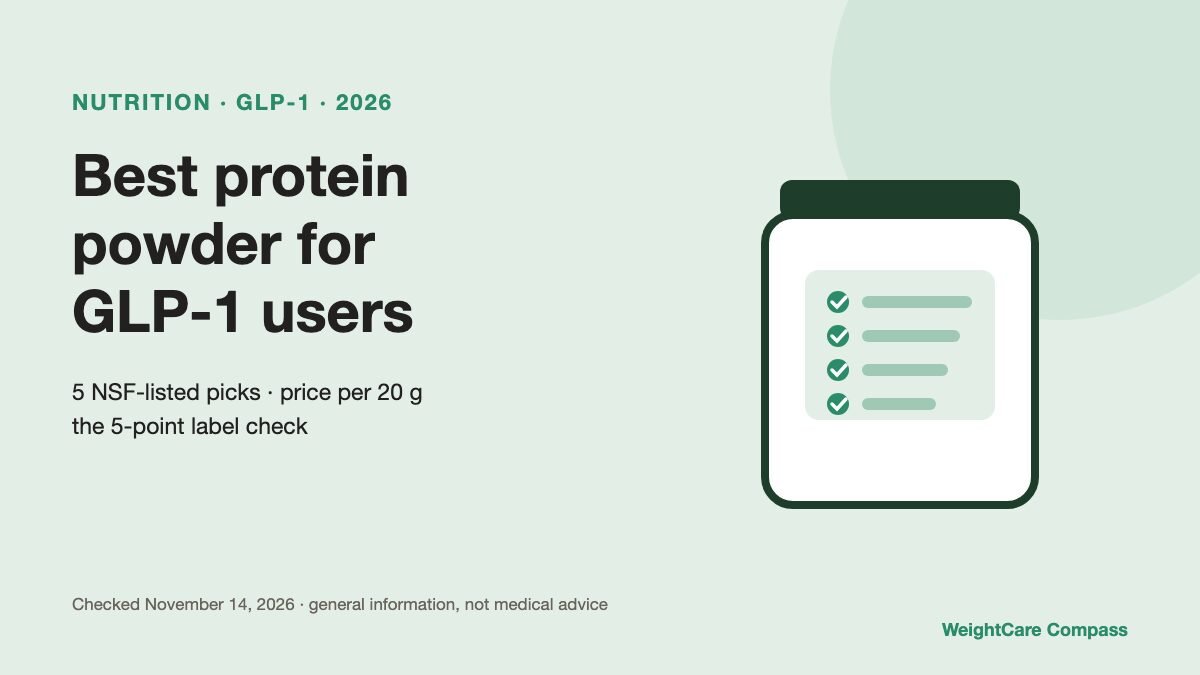
The best protein powder for GLP-1 users is one your stomach tolerates that gives about 20 to 28 g of protein per scoop, little or no added sugar, and an independent certification you can check yourself. All five powders below are listed, in at least some flavors, in NSF’s Certified for Sport database, which we checked on November 14, 2026.
We did not taste-test anything. We compared what the labels, the certifier and the official brand pages say, and we worked out what each powder really costs per 20 g of protein. First, the trial numbers that explain why protein and strength training matter on these medicines.
Key takeaways in 30 seconds
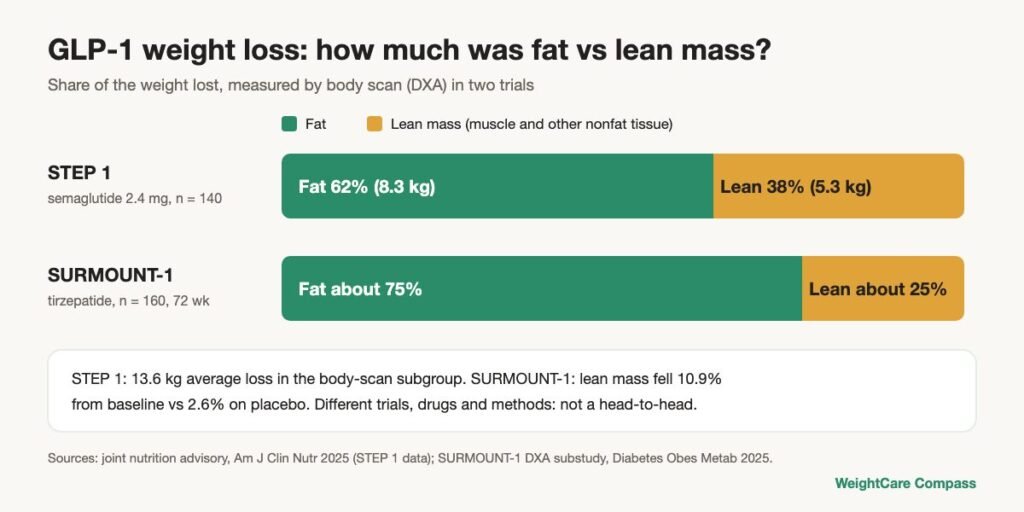
- In the STEP 1 body-scan subgroup, 38% of the weight lost on semaglutide was lean mass. Experts say more protein alone is “likely inadequate” to preserve muscle without strength training.
- One 20-28 g serving covers 17-35% of the 80-120 g daily range quoted by a 2025 expert advisory. Food stays the base.
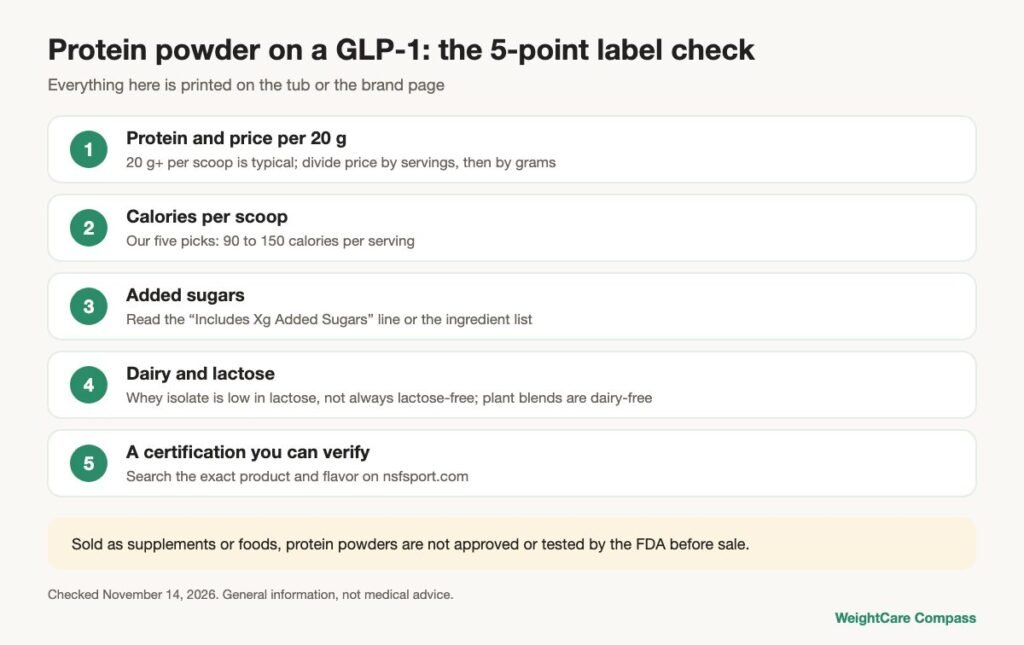
- Check five things on the label: protein and price per 20 g, calories, added sugars, dairy, and a certification you can look up.
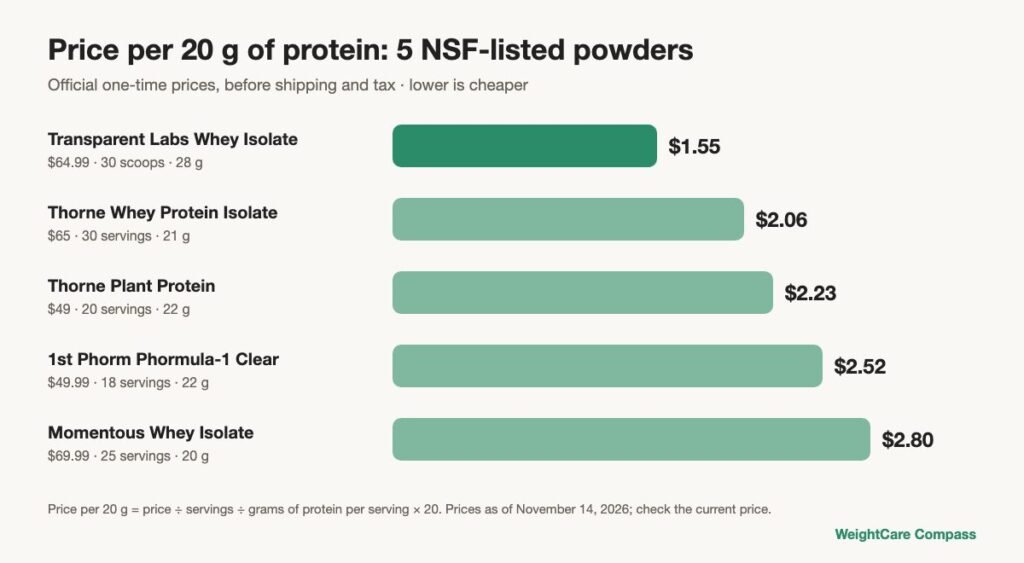
- Price per 20 g of protein ranges from $1.55 to $2.80 among our five picks (official one-time prices, November 2026).
Contents
Why does protein matter more when you’re on a GLP-1?
GLP-1 medicines cut appetite, so you eat less of everything, protein included. And part of the weight you lose is lean mass, not just fat.
Two trials measured this with body scans. They used different methods, so read them side by side, not as a head-to-head:
- STEP 1 (semaglutide 2.4 mg). In the trial’s body-scan (DXA) subgroup of 140 people, the 2025 joint nutrition advisory reports an average loss of 13.6 kg (about 30 lb): 8.3 kg of fat (62%) and 5.3 kg of lean mass (38%). Lean mass includes muscle and other nonfat tissue. The advisory, from four US medical and nutrition societies, estimates that muscle is about half of lean mass, so roughly 20% of the weight lost was muscle. Trial details are in the STEP 1 paper in NEJM.
- SURMOUNT-1 (tirzepatide). In a DXA substudy of 160 people (all tirzepatide doses pooled), after 72 weeks fat mass fell 33.9% and lean mass 10.9% from where people started, vs 8.2% and 2.6% on placebo. About 75% of the weight lost was fat and 25% lean mass, in both groups.
The first metric is “share of the weight lost”. The second is “change from your own starting lean mass”. They are not the same number.
The advisory adds a key point: more protein alone is “likely inadequate” to preserve muscle without structured resistance or strength training. Lifting, bands or body-weight work is the other half of the plan. A powder is a tool for the protein half only.
Whether you take Wegovy or Zepbound (FDA-approved for chronic weight management) or Ozempic or Mounjaro (approved for type 2 diabetes), these numbers come from trials, and your own results will vary.
How much protein do guidelines suggest, and how much can one scoop cover?
Guidelines give ranges, not a number for you. Here is what they say, quoted as written:
| Source | Protein range | Who it’s for |
|---|---|---|
| Recommended Dietary Allowance (RDA), quoted by the advisory | 0.8 g per kg of body weight per day | general adults (under review) |
| 2025 joint advisory | 1.2-1.6 g/kg/day “proposed during active weight reduction”, or 80-120 g a day | adults losing weight, including on GLP-1s |
| Dietary Guidelines for Americans 2025-2030 | 1.2-1.6 g/kg/day, “adjusting as needed based on your individual caloric requirements” | general population |
The advisory also says intake should not drop below 0.4-0.5 g/kg/day and that prolonged intake of 2 g/kg/day or more “should be avoided due to potential adverse health effects.”
Our calculation. The five powders below give 20 to 28 g of protein per serving. Against the advisory’s 80-120 g a day range, one serving covers 17% (20 g of 120 g) to 35% (28 g of 80 g). So a shake can fill a gap on a low-appetite day, but meals still carry most of the load. The advisory notes that “some individuals can meet protein targets” with high-protein shakes, bars and other fortified products.
Your own number depends on your body, your kidney function and your treatment plan. Set it with your clinician or a registered dietitian. To see how much weight trials suggest you might lose, try our GLP-1 weight loss calculator.
What should GLP-1 users check on a protein powder label?
Five checks cover most of what matters when your appetite is small. Each one is printed on the tub or the brand’s page.
- Protein per scoop and price per 20 g. Most powders in this group give 20 g or more per serving. Divide the price by servings, then by grams of protein, to compare fairly (we did it for you in the table below).
- Calories per scoop. With a small appetite, a scoop that is mostly protein leaves more room for meals. Our five range from 90 to 150 calories per serving.
- Added sugars. Read the “Includes Xg Added Sugars” line on Nutrition Facts panels, and the ingredient list on Supplement Facts panels.
- Dairy and lactose. Whey isolate is filtered to remove most lactose, but brands don’t all promise zero. If you avoid dairy, a plant blend is the simpler choice.
- A certification you can verify. A logo on the tub is not proof. Search the exact product and flavor in NSF’s Certified for Sport database. NSF says its Certified for Sport program verifies that what’s on the label matches what’s in the product, screens for 290 substances banned in sport, checks for unsafe levels of contaminants, and audits the manufacturing facility. It doesn’t mean a powder is effective or right for you.
Not FDA-approved. Protein powders are sold as dietary supplements or as foods, and the FDA does not approve or test them before they are sold. In its questions and answers on dietary supplements, the FDA says it “does not have the authority to approve dietary supplements before they are marketed” and “does not test dietary supplements before they are sold to consumers.” That’s one reason a third-party certification you can look up is useful, even though it checks contents, not results.
Best protein powder for GLP-1 users: the 5 picks compared
Price per 20 g of protein is the fairest way to compare a 20 g scoop with a 28 g one. Here are the label facts side by side.
| Powder | Type | Protein / serving | Calories | Sugar | Dairy | Price per 20 g protein | Buy |
|---|---|---|---|---|---|---|---|
| Transparent Labs Grass-Fed Whey Protein Isolate | whey isolate | 28 g | 120-150 (by flavor) | see label | yes (“virtually lactose-free”) | $1.55 ($64.99 / 30 scoops) | See pricing |
| Thorne Whey Protein Isolate | whey isolate | 21 g | 100 | 2-3 g by flavor (includes cane sugar) | yes | $2.06 ($65 / 30) | See pricing |
| Thorne Plant Protein | pea, brown rice, chia | 22 g (2 scoops) | 130-140 (by flavor) | 0 g added | no (vegan) | $2.23 ($49 / 20) | See pricing |
| 1st Phorm Phormula-1 Clear | clear whey isolate | 22 g | 90 | 0 g | yes (“0g lactose”) | $2.52 ($49.99 / 18) | See pricing |
| Momentous Whey Protein Isolate | whey isolate | 20 g | 90 | under 1 g | yes (not guaranteed lactose-free) | $2.80 ($69.99 / 25) | See pricing |
How we compared. No taste test and no “we tried it”: we read official product pages and label panels on November 14, 2026. Price per 20 g = official one-time price ÷ servings ÷ grams of protein per serving × 20, before shipping and tax. Subscription prices are lower and noted below. Prices are as of November 2026; on Amazon or other retailers, check the current price. Certification: each product was listed in the NSF Certified for Sport database when we checked on November 14, 2026, and listings are per flavor. We could not check the Informed Choice database with our tools, so we make no Informed Choice claim. Our methodology explains how we list products by need, not by commission.
What the evidence says. No published trial has tested any of these five powders, or protein powder in general, in people taking GLP-1 medicines, so none can claim to protect your muscle (evidence for that use: weak). What is better supported is the combination the 2025 joint advisory recommends: enough protein, mostly from food, plus regular resistance training. There is no evidence that clear whey, or any powder, eases GLP-1 nausea. The label facts and NSF listings above are things you can check, but certification is about what’s in the tub, not results.
Which powder fits which need?
There is no single winner: the right pick depends on your budget, your stomach and whether you eat dairy. These are listed by need, not ranked. Label numbers are in the table above; here is what the table can’t show.
Biggest scoop, lowest cost per gram: Transparent Labs Grass-Fed Isolate
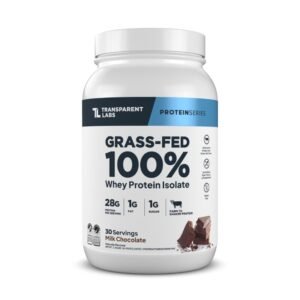
Fits you if you want the most in one scoop for the least money.
- One scoop (about 32 g of powder) mixes with 6 to 8 oz of liquid, the brand says.
- Sold in 2 lb and 4 lb tubs; the brand reports 1 g of fat a serving.
- Most flavors are NSF-listed, but not all (we did not find Peanut Butter), so check yours.
Limit: sugar varies by flavor and isn’t listed on the main page, so read the panel. The brand itself says people with a milk allergy or severe lactose intolerance should not use whey powders.
Classic milky shake, every flavor certified: Thorne Whey Isolate
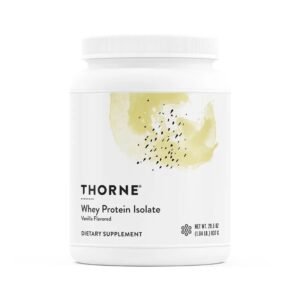
Fits you if you want a mid-priced shake where every flavor sold is certified: both chocolate and vanilla appear in NSF’s database.
- Subscription: $58.50, which works out to $1.86 for every 20 g.
- Sweetened with cane sugar (listed as evaporated cane juice sugar in vanilla) and stevia (rebaudioside A), according to the ingredient lists.
Limit: it contains dairy, and that cane sugar means it isn’t sugar-free.
Dairy-free: Thorne Plant Protein
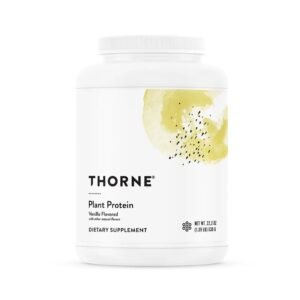
Fits you if you avoid dairy or eat vegan.
- Made from pea, brown rice and chia.
- Subscription: $44.10, or $2.00 per 20 g. Chocolate and vanilla are both certified.
Limit: one serving is two scoops, which can feel like a lot when you’re full fast.
If thick shakes are hard to finish: 1st Phorm Phormula-1 Clear
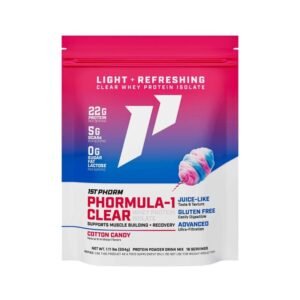
Fits you if milky shakes feel heavy and you’d rather try what the brand calls a “juice-like” drink.
- Zero carbs and zero fat, the brand says.
- The $44.99 subscription (10% off) renews automatically, every three weeks by default, until you cancel.
- Only three of its eight flavors appeared in NSF’s database when we checked: Grape, Lemonade and Tropical Punch.
Limit: we found no study showing that clear whey eases GLP-1 nausea. Tolerance is personal.
Low calories and an unflavored option: Momentous Isolate
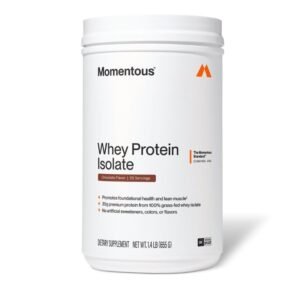
Fits you if you want a small, lean scoop, or an unflavored powder to stir into foods you already eat.
- Contains ProHydrolase, a digestive enzyme blend added by the brand.
- Unflavored, chocolate and vanilla are certified (strawberry was not listed when we checked). Subscribing takes 25% off the first delivery ($52.49, about $2.10 per 20 g), then 10% off later deliveries ($62.99, about $2.52 per 20 g).
Limit: the priciest one-time option here, and the brand says it isn’t guaranteed lactose-free.
Whey isolate, clear whey or plant: which is easier on a GLP-1 stomach?
Nobody knows for sure: we found no published trial comparing protein powders in people taking GLP-1s. Tolerance is individual, so start small.
Digestive side effects are common on these medicines, which slow how fast the stomach empties. In the trials summarized by the advisory, nausea affected 44% of people on semaglutide 2.4 mg vs 16% on placebo, and 28% on tirzepatide 15 mg vs 8% on placebo. Diarrhea affected 30% vs 16% and 23% vs 8%.
Practical, low-risk ways to try a powder:
- Start with a half serving, and sip slowly instead of drinking it fast.
- Buy a single-serve packet or small size before a full tub, where the brand sells one.
- If dairy bothers you, an isolate has less lactose than other wheys, and a plant blend has none.
If nausea, vomiting or diarrhea won’t stop, contact your prescriber. The advisory warns that dehydration from these side effects has been linked to kidney problems. If you’re also comparing the pill forms, see Foundayo vs Wegovy pill.
Who should talk to a clinician or dietitian before adding protein powder?
Most adults can add a shake, but some should check first, because their protein needs or risks differ.
Talk to your care team first if you:
- have kidney disease or reduced kidney function;
- have a history of an eating disorder (the advisory says GLP-1 prescribers should screen for this and refer to specialists);
- are pregnant, planning a pregnancy or breastfeeding;
- have a milk allergy (whey is made from milk) or another food allergy (read the allergen statement on the label);
- take insulin or a sulfonylurea: the Zepbound prescribing information warns that combining a GLP-1 medicine with these drugs can raise the risk of low blood sugar, so ask your prescriber before changing what or how much you eat;
- are under 18.
The advisory recommends individualized nutrition care from a registered dietitian when one is available. For more on eating and training on a GLP-1, browse our nutrition and fitness guides, and read our medical disclaimer.
What to read next
- GLP-1 weight loss calculator: see how much weight trials suggest you might lose, and why protein matters along the way.
- Cheapest GLP-1 without insurance: what the medication itself costs each month.
- Foundayo vs Wegovy pill: how the two daily pills compare.
Frequently asked questions
Can protein shakes cause constipation?
They can for some people, especially with little fiber or fluid during the day. Constipation is also a GLP-1 side effect: 24% on semaglutide 2.4 mg vs 11% on placebo, and 11% on tirzepatide 15 mg vs 5% on placebo in trials. Drink fluids, eat fiber, and tell your prescriber if it lasts.
Does collagen protein count?
Collagen grams count toward the protein total on a label. Collagen is a different kind of protein from the whey and plant blends compared above, though. Ask a registered dietitian whether it fits your plan before you rely on it as your main protein shake.
Can protein shakes replace meals?
A protein shake mixed with water is not a full meal. The powders above give 90 to 150 calories and mostly protein per serving. Ask a dietitian before swapping meals for shakes.
Does protein powder expire?
Yes. Check the best-by date printed on the tub, since quality can decline after it. Keep the container sealed and store it somewhere cool and dry, as the label directs.
Conclusion
The best protein powder for GLP-1 users is the one you’ll actually finish, with enough protein per scoop, little added sugar and a certification you can look up. Food stays the base: a shake only fills gaps on low-appetite days. Pair it with strength training and set your protein range with your clinician or a registered dietitian.
This article is for information only and is not medical advice. Talk to your clinician or a registered dietitian before changing your diet, and to your prescriber before starting, stopping or changing any medication. How we work: trial numbers come from the published papers and the 2025 joint advisory; product facts and prices come from official brand pages and label panels; certifications were checked in NSF’s Certified for Sport database. We did not test or taste any product. We last checked everything on November 14, 2026.